#e4mExclusive: TAM, DPOs move to fill ratings void; Fastway, UCN, DEN next after GTPL
More distribution platforms are exploring audience measurement using return path data, with TAM handling the backend as the industry searches for alternatives amid the television ratings freeze
 by
Published: Oct 26, 2026 9:18 AM | 6 min read
 Follow Us


- Fastway, UCN, DEN, and other distribution platform operators (DPOs) are developing their own television viewership measurement systems using return path data (RPD), following GTPL Hathway's initiative to publish channel viewership information.
- TAM Media Research is managing a common backend to collect viewing data from these DPOs, with plans to aggregate data for a comprehensive understanding of television consumption, amid the absence of a common ratings currency after BARC's suspension.
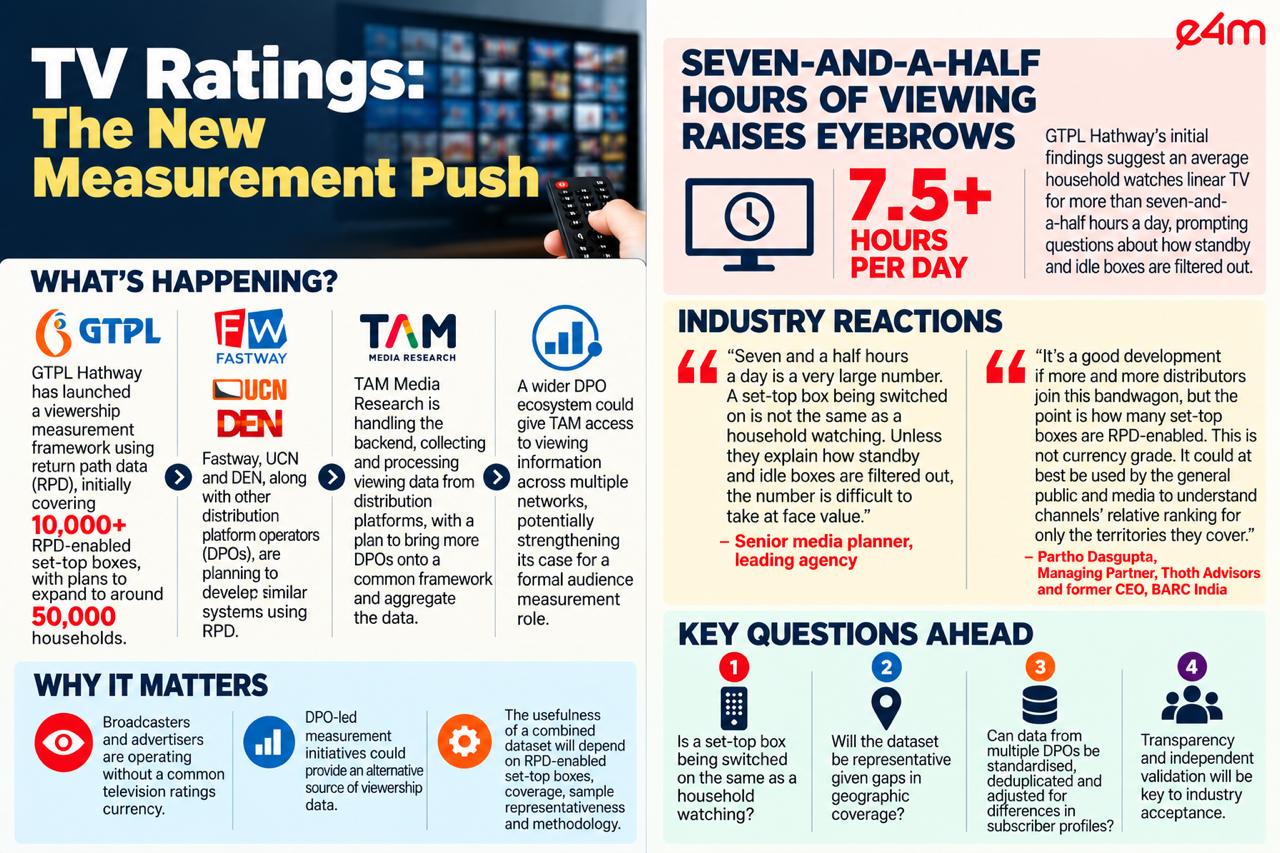
- GTPL Hathway's initial findings suggest an average household watches linear television for over seven-and-a-half hours daily, raising concerns about the accuracy of this metric and the methodology used to filter set-top box activity.
- The success of the proposed measurement framework will depend on the availability of RPD-enabled set-top boxes, the representativeness of the sample, and the consistency of data collection methods across participating DPOs.
Fastway, UCN and DEN, along with other distribution platform operators (DPOs), are planning to develop their own television viewership measurement systems using return path data (RPD), following GTPL Hathway’s move to publish channel viewership information, according to multiple industry sources.
The initiatives are expected to build on a common backend being handled by TAM Media Research, which is collecting viewing data from distribution platforms. The longer-term plan is to bring more DPOs onto a common framework and aggregate their data to generate a wider picture of television consumption, potentially strengthening TAM’s case for a formal audience measurement role.
The development comes as broadcasters and advertisers continue to operate without a common television ratings currency following the suspension of ratings published by the Broadcast Audience Research Council of India (BARC). TAM has applied to the Ministry of Information and Broadcasting for a licence to operate as a television audience measurement body.
e4m was first to report that GTPL Hathway has launched a viewership measurement framework based on RPD, initially covering more than 10,000 RPD-enabled set-top boxes. It plans to expand its sample to around 50,000 households.
The proposed expansion of the DPO ecosystem could give TAM access to viewing information across multiple distribution networks, rather than relying on the subscriber base of a single operator. However, the extent to which the combined dataset can support an industry-wide measurement system will depend on the availability of RPD-enabled set-top boxes, geographic coverage, sample representativeness and the methodology used to process the data.
Also Read: GTPL Hathway launches TV viewership measurement framework amid ratings freeze
As BARC ratings blackout persists, CTV industry plans independent measurement framework
TAM looks to build a common measurement framework
TAM’s role in handling the backend could become significant as more distributors explore publishing viewership data. A common processing and aggregation framework would allow data collected from participating DPOs to be brought together, potentially reducing fragmentation between individual platform-level measurement initiatives.
The model would also give TAM an opportunity to develop the data infrastructure required for its proposed measurement service. Its application for a ratings licence signals an effort to re-enter television audience measurement, with RPD expected to form an important component of its proposed model.
“The real opportunity lies in getting multiple distribution platforms to participate in a common framework. But aggregation cannot simply mean pooling data from different operators. The datasets need to be standardised, checked for duplication and adjusted for differences in subscriber profiles before they can provide a meaningful picture of television consumption,” said an industry executive familiar with audience measurement.
The distinction is between aggregating viewing data and establishing a recognised television ratings currency. Individual DPOs can report viewing patterns within their respective subscriber bases, but a combined system would need to address differences in subscriber profiles, geographical distribution, device penetration and data collection.
Under the Television Rating Policy, 2026, distribution platforms are permitted to publish periodic viewership data for channels carried on their platforms on their websites. However, the usefulness of a combined dataset will depend on how consistently the platforms collect and report information, and whether it can represent television viewers beyond the participating networks.
Seven-and-a-half hours of viewing raises questions
The GTPL Hathway initiative has also prompted questions about the interpretation of its initial findings, particularly its estimate that an average household watches linear television for more than seven-and-a-half hours a day.
“Seven and a half hours a day is a very large number. A set-top box being switched on is not the same as a household watching,” said a senior media planner at a leading agency. “I apprehend some basic technical details has been missed. Unless they explain how standby and idle boxes are filtered out, the number is difficult to take at face value.”
Partho Dasgupta, managing partner at Thoth Advisors and former chief executive of BARC India, said greater distributor participation would be a positive development, but questioned whether enough set-top boxes were RPD-enabled to support meaningful measurement.
“It’s a good development if more and more distributors join this bandwagon, but the point is how many set-top boxes are RPD-enabled. Way back in 2017/18 we (the erstwhile BARC team) had recommended RPD to TRAI and then to MIB,” Dasgupta said.
He added that the data, in its current form, should not be treated as a ratings currency.
“Honestly, this is not currency grade. This could at best be used by the general public and media to understand channels’ relative ranking for only the territories they cover,” he said.
Dasgupta pointed to gaps in GTPL Hathway’s geographical coverage, saying the operator did not cover key Hindi-speaking markets such as Uttar Pradesh, Rajasthan and Madhya Pradesh, as well as large parts of Maharashtra.
“This could at best be used by the general public and media to get an idea of overall rankings in the territory. Demographics and individual cuts are not available. There is no disclosure on their statistical methodology for establishment and sampling methodology to ascertain whether it represents Indian video viewers,” he said.
Scale alone may not establish a ratings currency
RPD can provide a continuous record of set-top-box activity and help identify channel consumption patterns. But device-level activity does not necessarily identify which individual household member is watching, making demographic estimates and individual audience profiles more difficult without supplementary research or other measurement techniques.
“RPD can provide scale and continuous viewing information, but the industry needs to distinguish between platform-level analytics and a national ratings currency. Advertisers need comparable reach, audience profiles and transparent methodology before they can use these numbers to make television investment decisions,” said another industry expert.
A wider RPD pool could improve visibility into channel switching, viewing duration and regional consumption patterns. But the number of connected set-top boxes alone would not establish whether the data represents the wider television-viewing population.
For TAM, the challenge will be to demonstrate that data collected from participating DPOs can be processed using a consistent methodology and translated into reliable audience estimates. Greater participation could strengthen the case for a common measurement framework, but transparency around sampling, weighting, geographic representation and independent validation will be critical.
The proposed multi-DPO approach could become an important component of the next phase of television measurement. Whether it can evolve into a credible alternative to conventional panel-based ratings will depend on the quality of the underlying data, the breadth of participation and the transparency of the methodology.
Read more news about Television Media, Digital Media, Advertising India, Marketing News, PR and Corporate Communication News
For more updates, be socially connected with us onInstagram, LinkedIn, Twitter, Facebook YouTube & Google News